15 years of service
Summaries
TowardS tighter ropes
In two studies for Swiss Red Cross — a project evaluation and a baseline for a successor project — we highlight what can be done to reinforce community resilience. The accelerating impact of the climate crisis is impetus to act holistically and at scale.
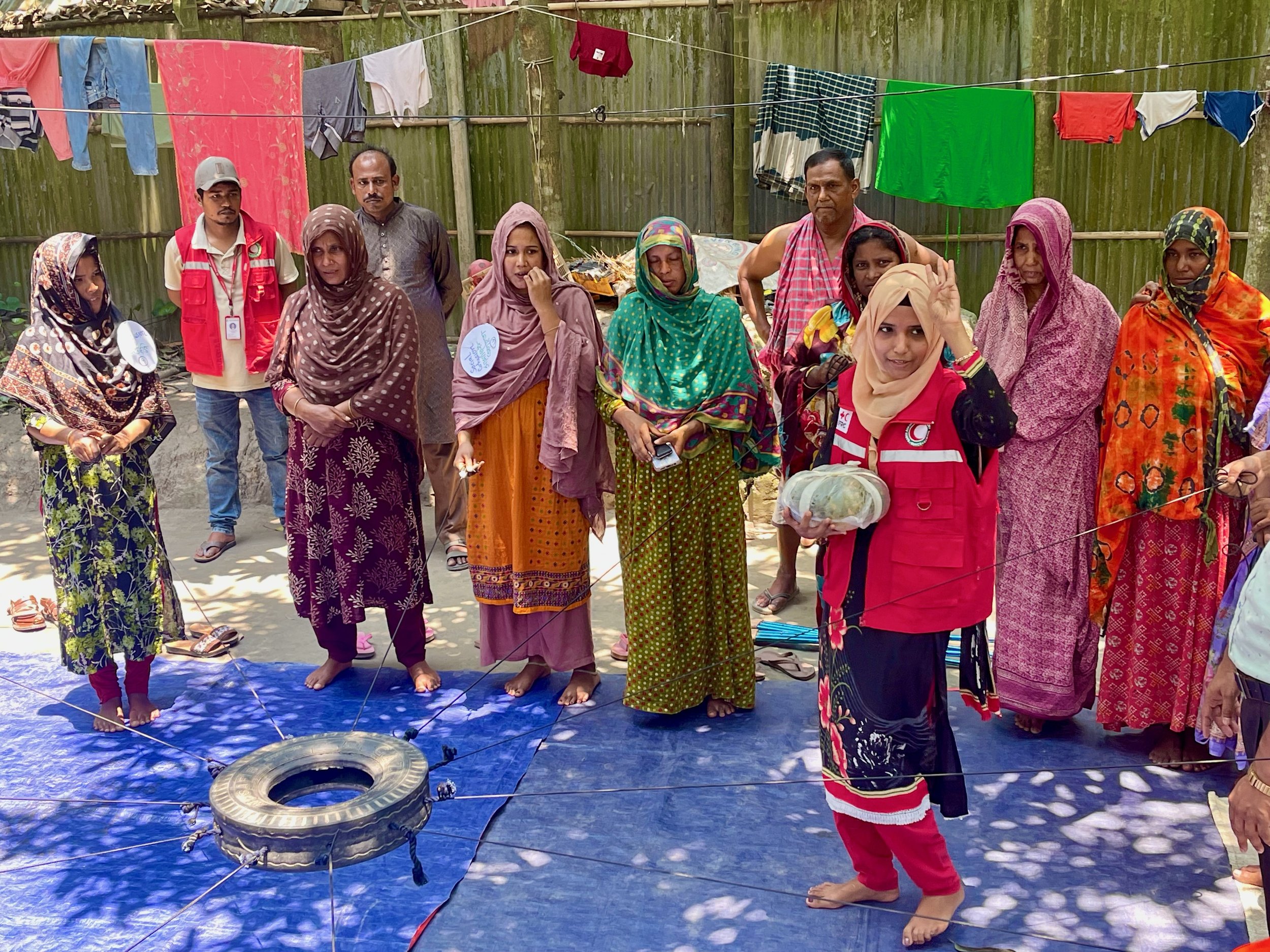
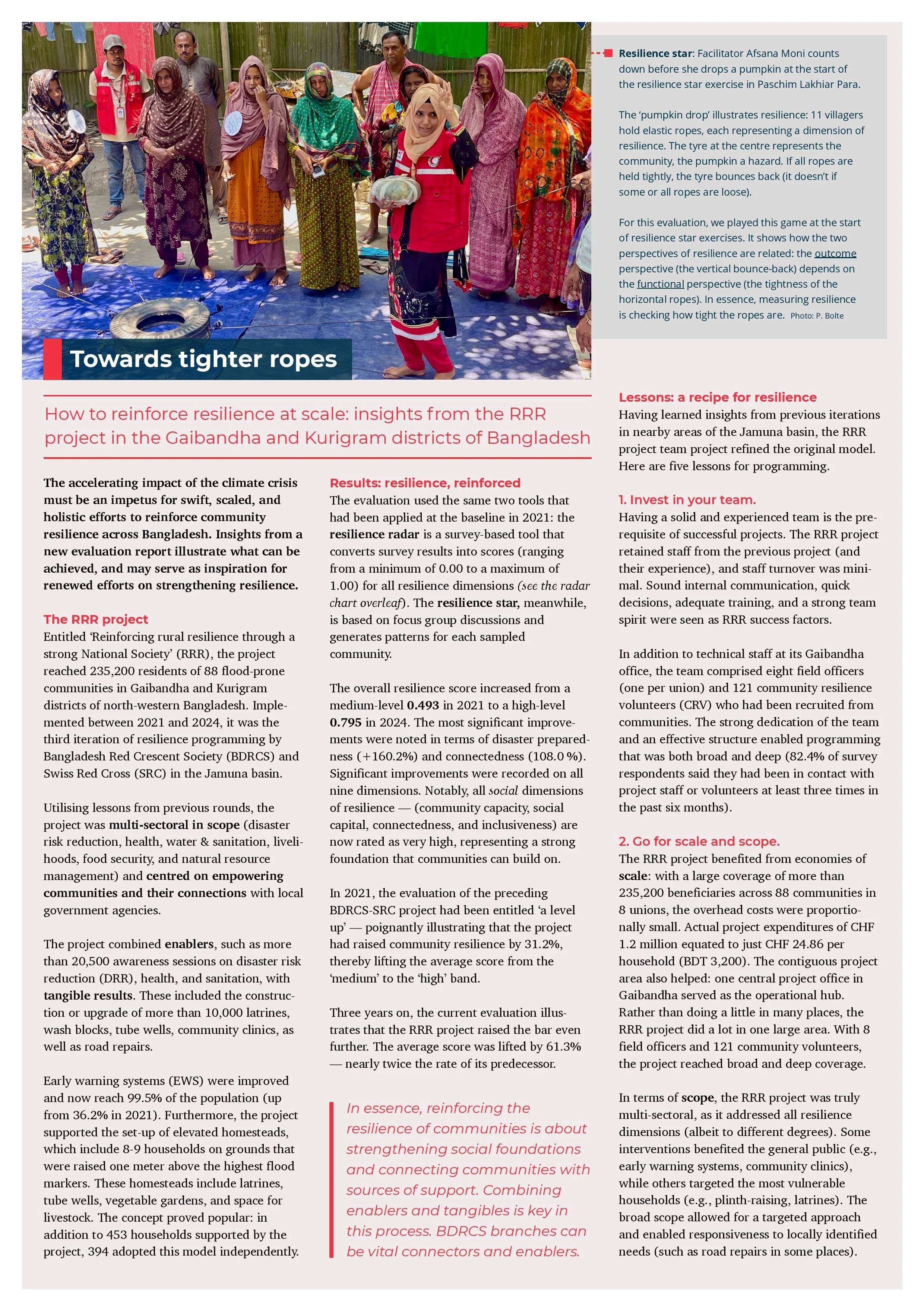
Facilitator Afsana Moni counts down before she drops a pumpkin at the start of the resilience star exercise in Paschim Lakhiar Para. The ‘pumpkin drop’ illustrates resilience: 11 villagers hold elastic ropes, each representing a dimension of resilience. The tyre at the centre represents the community, the pumpkin a hazard. If all ropes are held tightly, the tyre bounces back (it doesn’t if some or all ropes are loose). For this evaluation, we played this game at the start of resilience star exercises. It shows how the two perspectives of resilience are related: the outcome perspective (the vertical bounce-back) depends on the functional perspective (the tightness of the horizontal ropes). In essence, measuring resilience is checking how tight the ropes are.
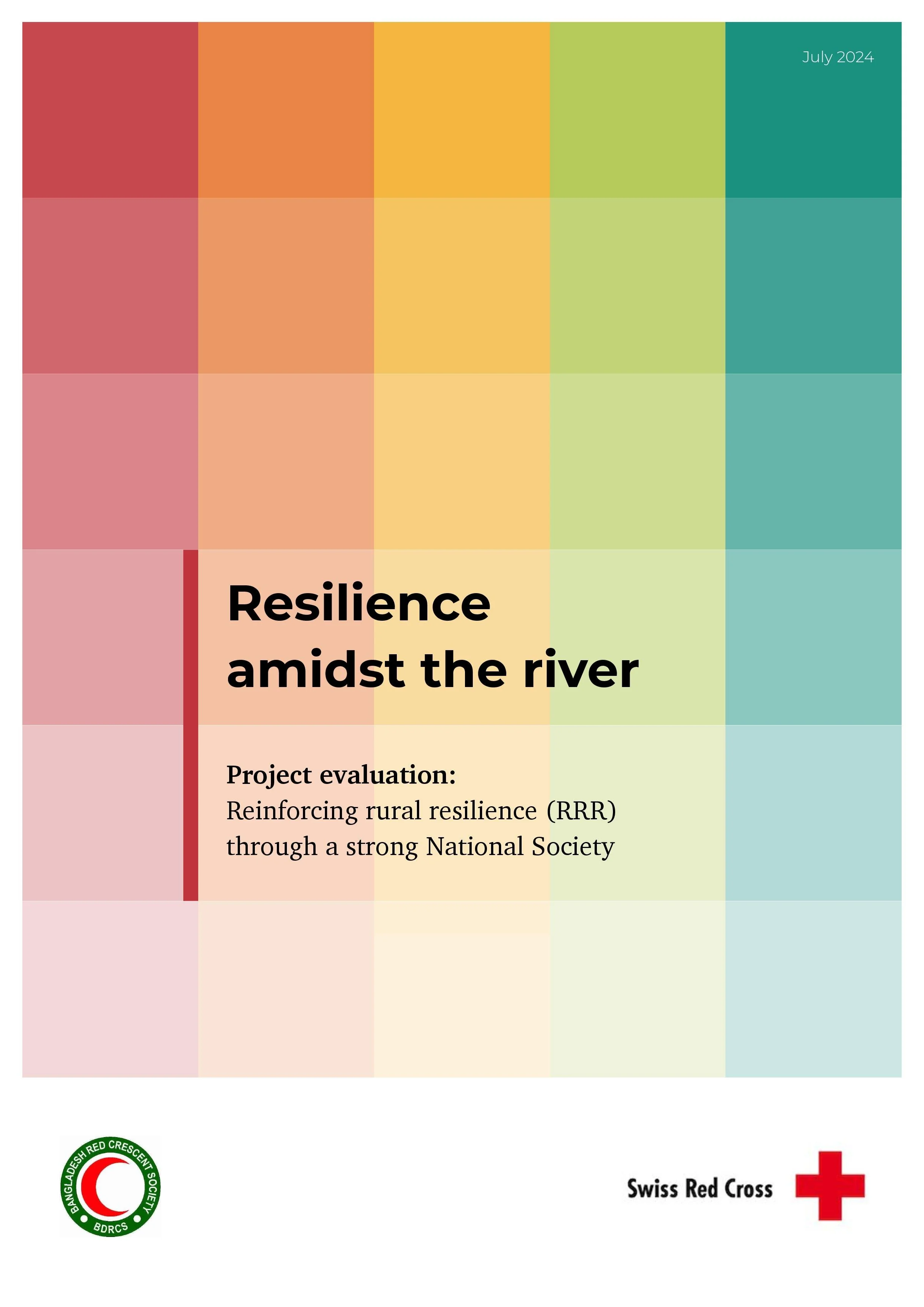

Conducted during sweltering heat in May 2024, the twin studies for Swiss Red Cross (SRC) highlight an effective approach of strengthening community resilience, as well as the urgent need for adaptation to climate change.
The evaluation of the RRR project, implemented by Bangladesh Red Crescent Society (BDRCS) and SRC between 2021 and 2024, is a powerful case study. With holistic programming and integral aspects to enhance the functions and connections of communities, the RRR project contributed to strong advances to community resilience. The evaluation noted a 61.3% increase in the average resilience score, as measured through the survey-based resilience radar. All social dimensions (community capacity, connectedness, social capital, and inclusion) are now rated as very high, representing a strong foundation that communities can build on.
The baseline study for the new Jamuna project, meanwhile, illustrates extreme levels of vulnerability and sensitivity to climate stressors in the new target area. Using the IFRC versions of the resilience radar (survey-based) and resilience star (discussion-based), the study identifies an average resilience score is just 0.32 (range: minimum 0.00 to maximum 1.00), and thus much lower than equivalent baseline scores for previous projects by BDRCS and SRC. The communities already experience strong effects of the climate crisis (increased frequency of human and animal diseases and crop failures were the most cited). However, knowledge of the climate crisis itself and of ways to adapt to it is very limited.
A summary of the two studies is also available.

Climate resilience
Read our climate resilience study for Danish Red Cross.

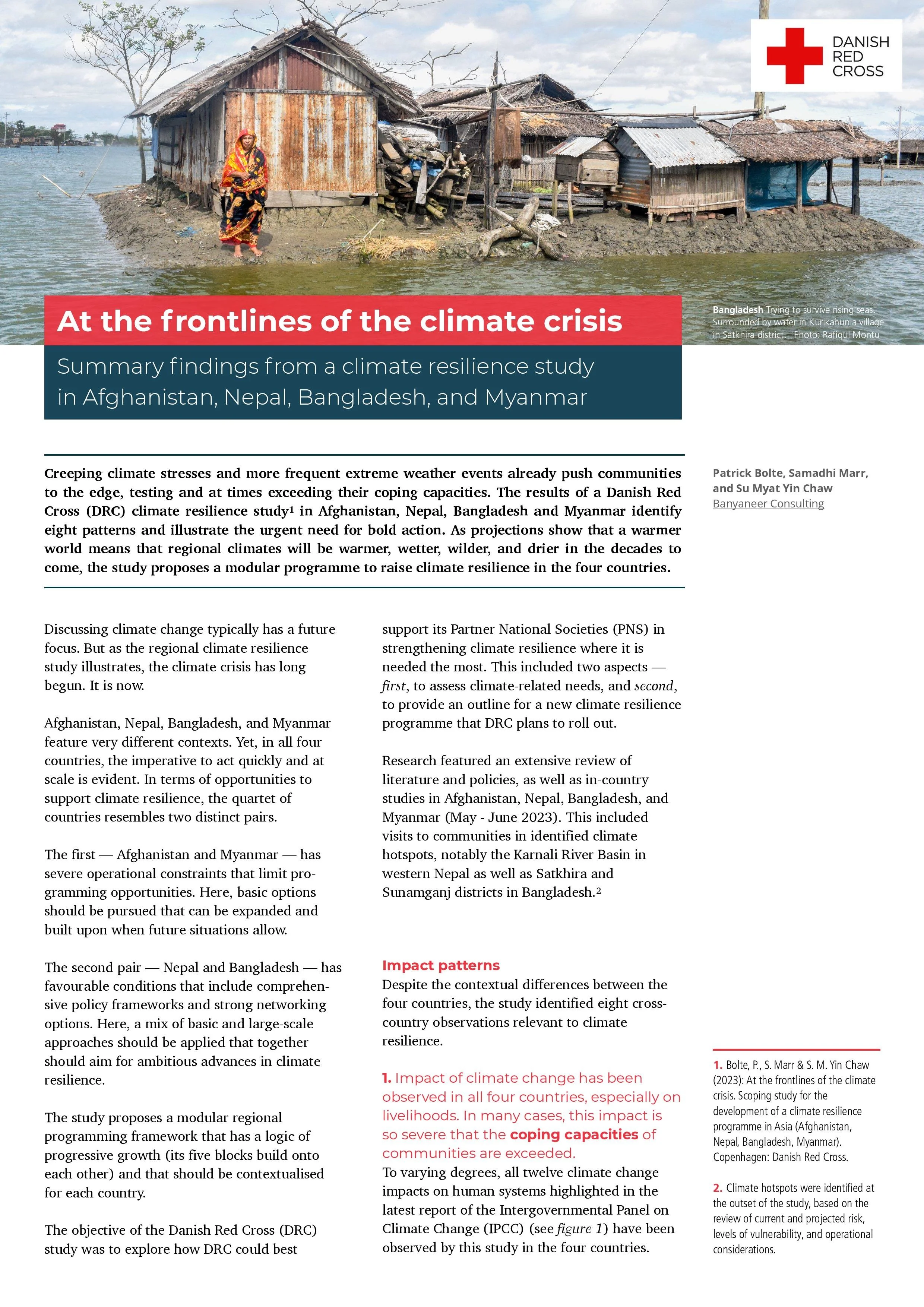
At the frontlines of the climate crisis: a climate resilience study that our team prepared for Danish Red Cross is now available. Afghanistan, Nepal, Bangladesh, and Myanmar: Creeping climate stresses and more frequent extreme weather events already push communities to the edge, testing and at times exceeding their coping capacities.
The study identifies eight patterns and illustrates the urgent need for bold action. As projections show that a warmer world means that regional climates will be warmer, wetter, wilder, and drier in the decades to come, the study offers guidance for a modular programme to raise climate resilience in the four countries.
For the study, Patrick Bolte travelled to Afghanistan and Bangladesh and Samadhi Marr to Nepal. Su Myat Yin Chaw contributed research on Myanmar. In identified climate hotspots such as Satkhira district of Bangladesh, they explored with communities the impact of climate change, as well as potential solutions to strengthen climate resilience.
The report includes an analysis of policies and possible partners for a new Danish Red Cross climate resilience programme, and culminates in a proposed modular programme outline.
A summary of the report is available here.
DRR Summer School
In 2023, Banyaneer and Oxford Brookes University for a truly exciting event.

In 2023, Banyaneer and Oxford Brookes University brought together five of the pioneers of DRR with 32 researchers and practitioners. Ian Davis, Terry Cannon, David Alexander, Maureen Fordham and John Twigg shared their insights and experiences and discussed with participants some of the most challenging aspects in disaster risk reduction.
To learn more about the DRR Summer School 2023, head to the website drr2023.com.
Reduce risk with nature.
A new handbook that we helped prepare for IFRC guides users to the most suitable nature-based solutions.

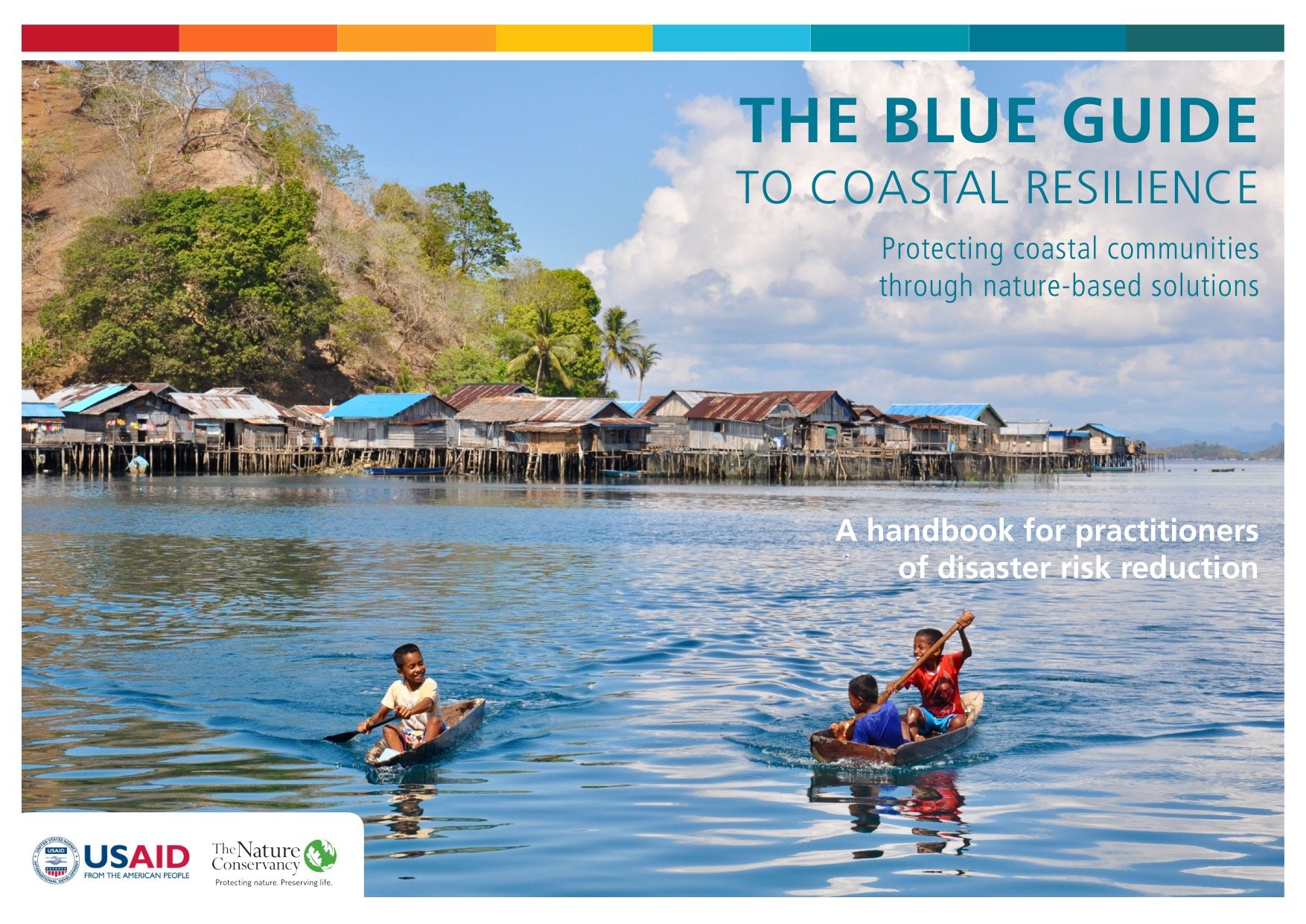
Since we started in 2010, nature has been part of our work to help raise resilience (it’s even in Banyaneer’s name). Our very first evaluation looked at a large-scale mangrove afforestation project in Vietnam (see IFRC 2011). Over the years, we analysed and advised efforts in which risk was reduced through nature in Cambodia, Timor-Leste, Papua New Guinea, and Myanmar. In 2021, we wrote The Blue Guide (The Nature Conservancy 2021), a guide on the use of nature-based solutions (NbS) in coastal settings.
The Nature Navigator (IFRC 2022) stands in that continuum and aims to inspire, guide, trigger, enhance, and enable action in reducing risk with nature. The handbook offers starter options (to raise awareness through action, as a stepping stone to think bigger), more advanced options in natural resource management (NRM) and nature-based solutions (NbS), and a section on the role of nature in disaster response and recovery.
Aligned with IFRC’s Road Map to Community Resilience, the Nature Navigator features an interactive format, case studies, one-page solution factsheets, as well as two toolboxes for the application of NbS and the facilitation of related trainings.
The public draft version is now available — following feedback from users, the final version will be created in 2023. To learn more about NbS, head to the IFRC NbS page and see key resources on our new NbS section. Our gratitude goes to the IFRC NbS team for excellent collaboration.
Questions
-
It depends. Nature-based solutions should meet certain standards defined by IUCN, and typically should create net benefits to ecosystems and to communities.
Planting a few trees in your backyard is not an NbS. Planting trees as part of broader forest or watershed restoration is typically an NbS.
Learn more in The Nature Navigator.
-
In many ways. NbS are essentially about sustaining and/or restoring ecosystems and the services they provide (just think of the breath you take while reading this sentence).
NbS offer protective benefits (e.g., a restored watershed can reduce flood risk). They can also bring many other tangible benefits and contribute to greater food and water security, health, and livelihoods.
Communities typically grow more resilient when they take ecosystem considerations into account through NbS and environmental stewardship.
Chapter 1 of the Nature Navigator (‘Foundations’) gives several examples.
Also related to nature-based solutions:

A Level Up.
Many projects aim to ‘build resilience’. But how do you measure the level of resilience?
We developed the resilience radar and refined other tools to gauge resilience (and project impact).
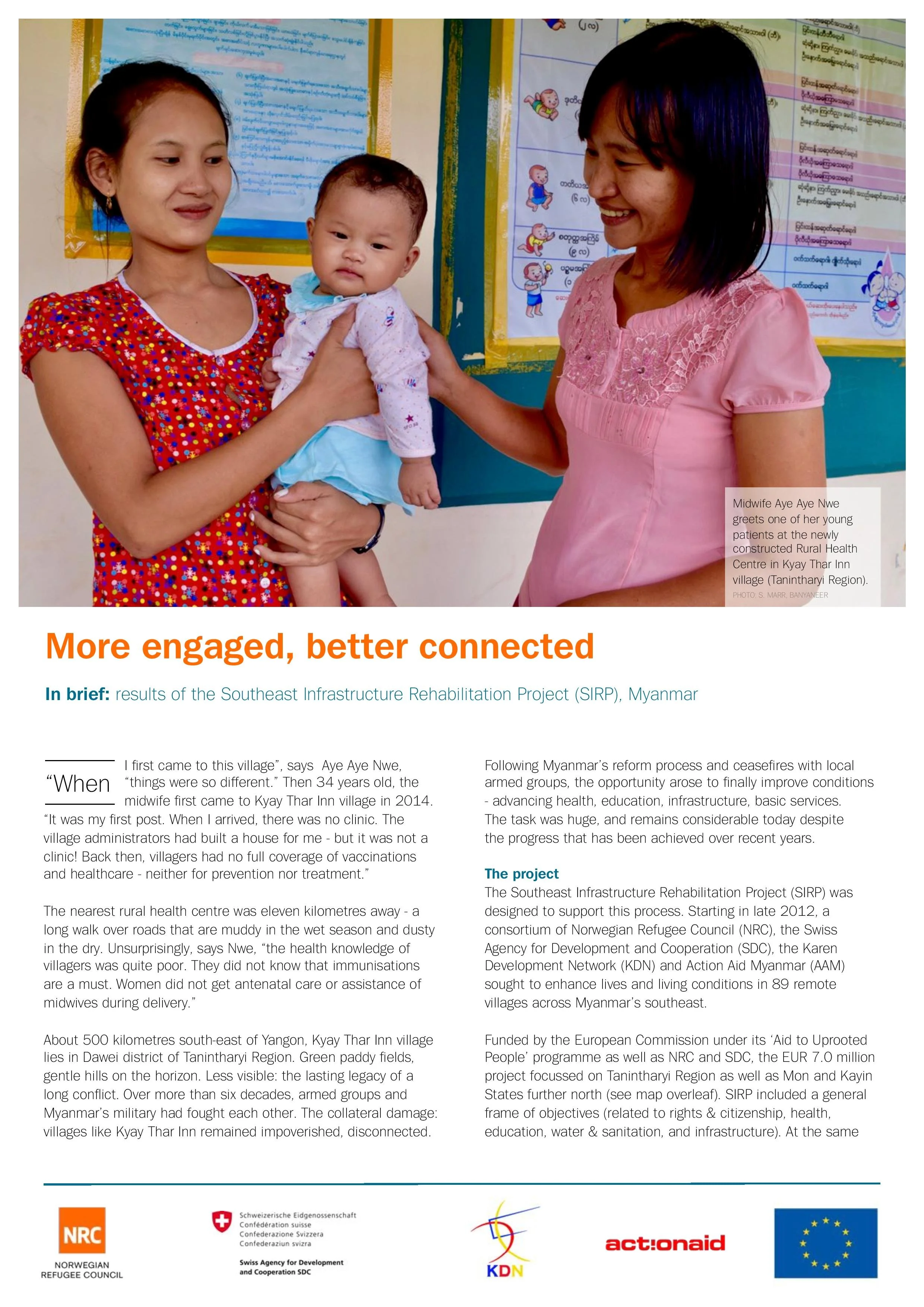
Our evaluation report for Swiss Red Cross that looked at a project in north-western Bangladesh showed remarkable results.
Raising resilience is a key task in humanitarian and development efforts — but how do you actually know whether your efforts have been effective? In 2017, Banyaneer developed the resilience radar as a practical tool that can be integrated into base- and endline surveys. In the same year, we applied the tool in conjunction with its qualitative sister (the resilience star) for the baseline of a disaster risk management project in Bangladesh’s flood-prone Gaibandha district.
We came back in 2021 for the endline and evaluation, and noted that resilience had increased on all measured dimensions — most notably in the areas that had been at the heart of the Bangladesh Red Crescent and Swiss Red Cross project (see illustration below).

Our report (‘A level up’) includes the first application of the resilience radar in a longitudinal comparison, and also commends the project team on strong efforts towards greater connectedness with local governments.
In 2022, we have applied a second longitudinal comparison in the context of a slum resilience project north of Dhaka. We also contributed to the development of IFRC’s resilience measurement dashboard, which features adjusted versions of resilience radar and resilience star as well as an interactive analysis suite.
Questions
-
Resilience can be seen from two perspectives: the outcome perspective is about the depth and length of a downturn in the wake of a crisis or disaster (i.e., what are the damages and losses, and how quickly does the community recover?).
The functional perspective looks at the characteristics a community needs to have to anticipate, adapt to, deal with, and recover from the impacts.
The resilience radar looks at the functional perspective and is based on a survey that translates responses into numerical values. On each dimension, there is a maximum score of 1.0 and a minimum of 0.0. As shown in the illustration, connecting these scores creates the resilience pattern, which can be compared between base- and endlines.
-
To measure resilience, it is prudent to apply mixed-method approaches. So in addition to the survey-based resilience radar, it is useful to apply qualitative tools such as the resilience star (based on focus group discussions), EVCA tools such as seasonal calendars and risk mapping, and resilience scans (which captures secondary information).
Collating data from different sources helps to understand the full picture and design targeted approaches to raise resilience.
-
We provide solutions for every stage of the project management cycle. We co-design projects, conduct needs assessments and baselines (using resilience measurement tools), mid-term reviews and evaluations.
At Banyaneer, we strongly believe in capturing and harnessing local knowledge and in developing projects that accompany, connect, and enable (ACE) communities.
Featured reports
DRR & Covid-19 in Africa: Guidance from the field

All of our reports are rigorously researched and professionally presented. See our reporting principles and past reports here.